
First dual gradient riser introduced
The Petroleum Equipment Division of Stewart & Stevenson Services, Inc., a leading manufacturer and distributor of well servicing products and drilling equipment, has introduced the first riser system specifically designed for future dual gradient, ultra-deepwater environments.
"The company's Dual Gradient Drilling Mud Return Marine Riser System (DMRS) uses a new design to take full advantage of dual gradient drilling and underbalance drilling without sacrificing the ability to be used as a conventional drilling riser system," says Tommy Wall, vice president and head of Stewart & Stevenson's Petroleum Equipment Division.
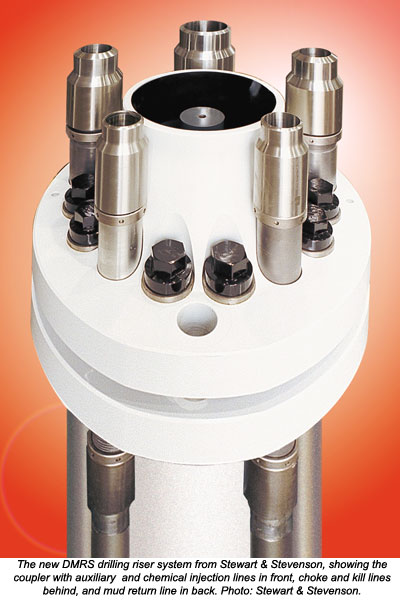
Wall explains that the company can meet future dual gradient as well as current conventional drilling requirements by the smooth integration of a large diameter drilling fluid return line and the new Stewart & Stevenson riser isolation tool (SSIT) into the drilling riser system. Both the DMRS riser system and the SSIT riser isolation tool are the subjects of pending patent applications.
"While the industry waits for the development of the equipment that will make dual gradient drilling possible and move underbalanced drilling offshore, Stewart & Stevenson's new DMRS riser system offers some significant advantages now for conventional drilling," says Wall. Some of the advantages he lists are:
Edited by Dev George
Managing Editor, Oil and Gas Online