
Independents Are Going for Unexplored Basins in West Africa
by Moses Aremu, Lagos
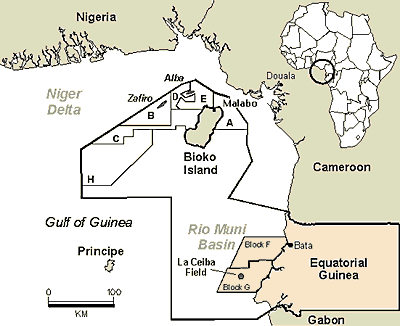
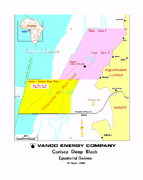
When Chevron arrived in Equatorial Guinea last May, it was hoping to sign for 15 blocks west, north, and south of Triton's storied blocks in deepwater Rio Muni Basin. Chevron officials were surprised to hear, however, that the Equatorial Guinea Government had awarded six of the blocks that were part of earlier negotiations to another company—they had gone to Vanco, a US independent that prides itself in being deepwater West Africa's largest acreage holder. In this increasingly important oil province, Vanco held over 16 million net acres, even before the recent acquisition in Equatorial Guinea. In sheer volume of acreage holding, Vanco beats Agip (with 9 million net acres) and the British minnow Dana Petroleum (with 7 million), in second and third places.
Even so, it was still surprising that Equatorial Guinea could consider Vanco Energy over Chevron. "If they really wanted someone to work the lease; acquire seismic, and drill wells in the near term, they should have opted for a major company," says a Malabo analyst. The government is reportedly uncomfortable with the fact that Atlas Petroleum, a Lagos, Nigeria-based independent, acquired leases in the same area only to start looking for buyers, and still without a work program. "Perhaps the government thought that Vanco is a big E&P company, going by the sheer size of its acreage holdings," the analyst argues.
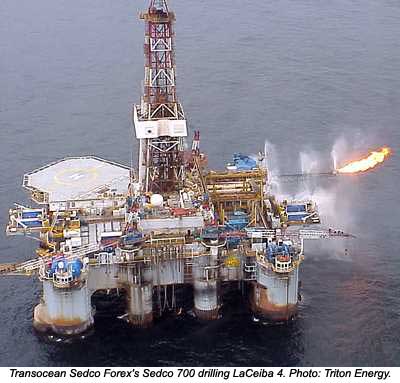
With a large spread, mostly in countries that have proved little or no oil, Vanco is easily accused of property speculation. Of the five countries in which it has leases, only Gabon holds up to a billion bbl oil in reserves. Vanco's largest spread in a single country (7.9 million acres} is in Senegal, which hardly shows up on the hydrocarbon map of the world. And, in Cote d'Ivoire, the company's assets are the farthest from producing properties. All of which makes the recent acquisition in Equatorial Guinea a little bit curious, as the two leases are closer to the country's much hyped, new discovery, La Ceiba Field, scheduled to go on stream in 2001.
Vanco's manager of New Ventures, Bill St John dismisses the misgivings that the company just acquires assets, waits for the value to go up and start looking for farm-ins.
"A primary focus for deepwater exploration for Vanco is the presence of major salt basins, which led us to Gabon , Equatorial Guinea, and Morocco. A secondary focus is quality source rock."
So is there something the majors are missing by ignoring Cote d'Ivoire, Ghana, Liberia, Togo, Morocco, Equatorial Guinea, and South Africa? What is in South Africa's Southern Outeniqua Basin that makes Ranger UK Limited so excited? And why does Ocean Energy want to stay in deepwater Cote d'Ivoire when Shell is keen to get out? Why does Dana Petroleum talk about Ghana as if it is the Holy Grail?
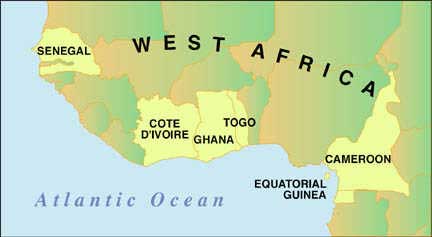
Somebody once remarked that deepwater West Africa is a playground of the majors. That statement ought to be qualified. The Vanco's and Dana's combined holdings in deepwater West Africa surpass those of ExxonMobil, Shell, and Agip together. The truth is, independents are pouring over West African deepwater data as much as the majors. Every active E&P company is aware of the trend from Abidjan to Namibia and would like to grab a piece. In press releases, Ranger, Dana, Vanco, Ocean Energy, Energy Africa, and several other independents, tout their involvement in the lucrative West African province. But as Nigeria and Angola discover pool after spectacular oil pool, the entry fees into these countries' deep offshore basins escalate, becoming too expensive for independents.
"We are essentially a deepwater exploration company," says Vanco's St John. "We do not explore onshore or on the continental shelves." A typical exploration target for Vanco is "formed by the corner intersections of transform and pull-apart margins. These normally form major river drainage and sand-rich deltas or fan depositions, as in Nigeria's Niger Delta," according to St John. So Vanco would love to be in Nigeria (to look for deltaic sands or fan deposition) or Angola (where the salt diapirs are preponderant), "but the signature bonuses expected in these countries are high."
"There is the perception of the smaller companies that they have not got the financial muscle to compete with the Shells of this world in places such as Nigerian deepwater," according to Phil Nelson, a consultant geologist who works on African basins out of an office in London. "Ranger's small presence in Angola is more historical than intentional."
Nelson should know. After working for Shell for 20 years, four out of which he spent in Nigeria in the 70s, he has consulted for Abacan Resources, a Canadian independent that featured prominently in the country in the early- to mid-90s.
Signature bonuses in Nigeria are not as high as Angola, partly because the latter has a better organized bureaucracy and official corruption is not as obvious, but mostly because Angola has done better in its deep offshore activity than Nigeria. Angola's estimated eight billion bbl of new deepwater oil compare better than Nigeria's 4 billion bbl, discovered in the same period (1995-2000) in similar provinces. Before the civilian government came in last year, Nigeria's military government was angling for signature bonus of US$20 million for each of 12 deep offshore leases of an average of 2,300 sq km each. Even then, only indigenous companies were permitted leases, mostly in backroom deals. Those companies in turn hawked the licenses to multinationals for negotiable sign-on fees in turn for favorable contracts that also allowed multinationals to operate the leases as if they held them. Even so, any E&P company interested in such a deal would spend nothing less than $30 million to secure the lease before work program really starts.
At its last licensing round in 1998, Angola asked for a $300 million signature bonus for each of four 5,000 sq km leases in the ultra-deepwater Congo Basin. She almost got all her wishes. A consortium led by BP Amoco got Block 31, TotalFinaElf is operating Block 32, as is Exxon Block 33. These companies paid the signature bonus as demanded. But the government is still looking for an operator and active partner in Block 34, which is held by a joint venture between the state-owned oil company Sonangol and Norsk Hydro.
Nigeria's current bidding round, offering mostly deepwater leases, has the oil patch abuzz about bigger signature bonuses than usual. This is Nigeria's second open licensing round in a decade. Companies are reportedly pledging at least $70 million on each lease to beat the competition. And, as in Angola, this is a turf battle involving only the majors.
Conversely, in Equatorial Guinea, less than $4 million are enough to close the deal for a lease of 3,000 sq km.
Other countries, Cote d'Ivoire, Ghana, Senegal, talk more about the investment; the jobs that will be created, the taxes after the first oil, as well as the value that status as an oil producer supposedly adds to the economy. The period of exploration can be up to nine years after signing the PSC. Evaluation and exploitation periods get up to 27 years. "Signature bonuses are really low for Equatorial Guinea," says a government source. "You want a lease?" he adds, "just come and talk." In most of these countries, the supplementary operator costs are negotiable.
Independents are not put off by countries with high bonuses, they tend to thrive in less prospective countries where "the reserves are too small for majors to be interested". Independents enjoy the close rapport with and the high esteem bestowed on them by the governments of those less-endowed countries, and they bask in the value they add to their quality of life. And they do not have to do too much to earn the applause.
Whereas Shell discovered Nigeria's first oil field, produces a third of the oil, spends huge sums on community issues, and leads the consortium of companies in the country's $3.8 billion LNG project, Shell has probably less respect in Nigeria than Ocean Energy does in Cote d'Ivoire. And all Ocean Energy did was revive an industry that was only briefly in decline; it arrived in January 1992 and delivered first oil from the block CI-12, in 1995, 27 months after the PSC. Ocean Energy also gave Cote d'Ivoire the first West Africa commercial gas field, Panthere, which was discovered in December 1993, testing 30 million cf/d gas and 942 b/d condensate. The oil field, Lion, flowed 23,696 b/d on discovery in March 1994. But Cote d'Ivoire is producing only 20,000 b/d oil—which is one percent of Nigerian production.
Even without yet producing a drop of oil, Dana feels big in Ghana. Its recent discovery, West Tano-1 was broadcast all over the newswires. The well had only flowed 1,000 b/d of heavy (20-degree API) oil in a channel sand whose extent is difficult to map. But then it is Dana's first discovery in West African offshore, and if and when the field successfully comes onstream, this small British operator would have made Ghana an oil producer.
Independents in West Africa often come across as if they spend all their time on comprehensive studies, unraveling the potentials of provinces that otherwise would be passed by. And many times the searchlight has worked. The historic Zafiro Field, which turned Equatorial Guinea from a putative gas producer to an oil rich country, was discovered in a lease that was initially granted to Ocean Energy, who later sold 75% of the tract, as well as operatorship to Mobil. Five years after that discovery, Triton Energy, another US independent, discovered the 100 million bbl La Ceiba Field in deep offshore Equatorial Guinea, specifically in the Rio Muni Basin which had been explored and left for barren by a succession of majors in the 1960-70s.
The picture fits: independents move into basins that appear barren, uninteresting to the majors, on rank wildcat basis; do the visioning process, and evaluate the possibilities, then the majors walk in to re-evaluate and embark on projects that eventually monetize the resources.