
Revolutionizing Oil And Gas Industry With The Internet Of Things
By Sanjeev Verma
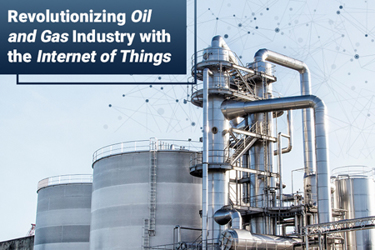
The Internet of Things has led several businesses and industries through innovation. Industries such as automobiles, manufacturing, healthcare, transportation, oil, and gas have now switched to a better and advanced level by using the Internet of Things. They have embraced IoT for various reasons like remote management, better security, automation, and data management. This article primarily focuses on how IoT has shaped the oil and gas industry.
The oil and gas sector is the most crucial sector to implement any technology. Any system failure, even the smallest of incorrect measurements or tiniest of the mistakes in this field would lead to huge losses and even tragic events like BP’s Deepwater Horizon Oil Spill. However, integrating IoT has made things much easier to manage and operate in the oil and gas sector.
Significance of IoT in Oil and Gas Industry
Statistically, it is quite impressive to see the soaring graph for IoT adoption in the O&G field. According to the researchers, the market for the Internet of Things is expected to reach around $39.40 billion in the coming years. Several companies across all parts of the oil and gas supply industries are coming forward to adopt IoT connectivity to enhance their machine capabilities and data processing for improved decision-making.
Internet of Things comes with two pivotal aspects for the oil and gas industry — efficiency and safety. IoT for refinery management, pipeline monitoring, and machine efficiency has minimized the workload and provided the professionals with great results. According to the stats and figures, non-productive time was the main reason for the loss of billions of dollars in previous years in the upstream segment of O&G industry. This loss led many professionals to transform their types of machinery and equipment by adding IoT. Switching the companies to an advanced platform like the Internet of Things; now they are able to use real-time data to predict and act accordingly for proper equipment maintenance. However, there are some challenges that these professionals face while using IoT.
Challenges
The oil and gas industries are required to stay competitive for sustainability. The advanced technologies and methods like cloud computing, analytics, and artificial intelligence have paved a way for these industries to excel. However, with the shifting demands and volatile prices, the O&G sector faces a lot of ups and downs. Implementing IoT with this industry has resulted in better outcomes but some of the main challenges faced are:
The Legacy Infrastructure
The oil and gas industry is all about huge drilling equipment, super-powered machines, big tanks, and complex monitoring systems. They have consistently performed rugged labor and thus, require regular monitoring for proper maintenance. Several oil wells rely directly on this legacy infrastructure and aging equipment. Thus, it requires more funds and manpower.
The Industrial Environment
It is another considerable aspect that challenges the oil and gas industry's accessibility. In some places, there are hazardous environments that hamper the maintenance of oil wells. The residue and wasteful deposits from these wells are often seen around offshore areas, which result in industrial pollution. Several oil-producing wells are established in risky areas of northern seas and gas pipelines connect through harsh desert zones. Thus, making it more difficult for the manpower to fix the breakage or leak in any of those pipelines by going onsite.
The Emission Control
We all are familiar with the fact that the O&G industry is the pillar of many economies, but still it has been greatly affected by the green energy sector. The environmental issues are growing rapidly and actions are being taken against carbon emissions. Thus, the IoT capabilities and other technologies have come into play to solve such challenges.
The technology in today’s times has shown its potential in solving the challenges as well as improved performance in the oil and gas industry. Applying IoT innovations with this sector has gained a lot of popularity and investment for better performance.
Benefits of IoT with Oil and Gas industries
Asset Monitoring and Maintenance
Internet of Things uses sensors on the assets to monitor things. Similarly, a network of sensors monitors the machines’ condition, identify pipe leakages, detects pressure, and helps provide real-time control over the entire plant processing. This real-time control offers quick addressing of the issues, increases the plant’s productivity, generates more ROI, and helps reduce the downtime of the machinery.
Health and Security of The Employees
Designing the refinery equipment with IoT, oil and gas companies can build a safer working environment for their employees. Generally, O&G sites are found at remote locations where it is quite difficult to manage the facilities manually. Hence, the Internet of Things can provide employees with a facility of remote equipment management. Furthermore, it minimizes the risk of the manpower required to travel onsite. It also helps in analyzing the exact conditions of the site and notify the employees priorly about any mishap like explosion, or leakage. Thus, helping them in making better and smart decisions.
Data management
Oil and gas refineries monitor a huge amount of data which is very useful for future analysis or predictions. Data plays an important role in business improvements, such as enhancing the recovery rates, better decision-making, and machine capacity. The advancement of IoT channelizes a better way to track refinery operations. Even the minutest detail of the measurements is being calculated with accuracy through the Internet of Things. It brings amplified capabilities of data analytics into action and simplifies the operations for the professionals.
Carbon Footprint control
IoT has proved to be beneficial in the oil and gas operations both financially as well as environmentally. The Internet of Things has laid a positive impact in this sector. It has multiplied the revenue and significantly divided carbon emissions.
How? — Usually, industrial pollution occurs through the large amount of smoke and pollutants belching out through big chimneys and pipelines. IoT uses sensor devices and by planting these devices on chimneys and pipelines, we can collect huge data on a daily basis, and generate reports. Collecting data and analyzing it through analytics tool would further help in identifying the pattern of the emissions, which would lead in taking improved actions and smart decisions towards reducing the carbon footprint.
Thus, IoT has resulted in lowering the environmental issues generated by oil drilling, and production operations.
Supply Chain Management
The oil and gas industry is looking for cost-cutting areas due to a consistent hike in oil prices. The supply chain is one such area where operational costs can be restructured. The Internet of Things allows companies to carry out planning, scheduling, and procurement processes effectively. Hence, supply chain management can be processed through IoT and that too with more efficiency. It will help the companies in analyzing and processing the data from multiple endpoints; hence, improved decision-making for further processes comes into play.
The Internet of Things has transformed our lives with automation and better productivity. In this era, it is quite difficult to imagine ourselves without implementing technology with our businesses. The oil and gas sector has improved itself in multiple ways and implementing IoT is a major improvement shown. After reading this article, it is very clear that the IoT has revolutionized the O&G industry. IT sector is thriving hard to provide these industries with the simplest and innovative solutions to overcome the challenges. Certainly, it will take a lot of time and effort to outgrow the oil and gas companies with IoT but the results will be remarkable.
 Sanjeev Verma is the founder and CEO of Biz4Group, based out of Orlando, FL the United States. He has conceptualized the idea of Biz4 Brand and founded Biz4Group, and Biz4Intellia. He has 20+ years of experience in boosting IT-based start-ups to success. In the past, he has worked on leadership positions with Marriott Vacations, Disney, MasterCard, Statefarm, and Oracle. The company headed by him excels in developing, implementing and monitoring Digital Solutions ranging from IoT solutions & products, Mobile and Web Development, and Digital Marketing to Full Stack Development and CMS solutions.